Two girls discover
the secret of life
in a sudden line of
poetry.
I who don’t know the
secret wrote
the line. They
told me
(through a third person)
they had found it
but not what it was
not even
what line it was. No doubt
by now, more than a week
later, they have forgotten
the secret,
the line, the name of
the poem. I love them
for finding what
I can’t find,
and for loving me
for the line I wrote,
and for forgetting it
so that
a thousand times, till death
finds them, they may
discover it again, in other
lines
in other
happenings. And for
wanting to know it,
for
assuming there is
such a secret, yes,
for that
most of all.
- Denise Levertov
Is there a secret of poetry too? What's the relationship between the secret of poetry and the secret of life? Discuss.
MFB,
L
Saturday, February 9, 2013
Tuesday, February 5, 2013
News From Heaven : A Mom & Me Review
![]() |
| Get it quickly by hopping here to Indiebound or Amazon. Available on all your likely e-readers too. |
News from Heaven, Jennifer Haigh’s most recent short story collection, echoes Sherwood Anderson’s American classic Winesburg, Ohio in that all its stories center around a small town. In this case, it’s rural Pennsylvania we revisit, and the stories take place from WWI era through to the present day, spanning nearly a century. If you imagine that such a setting couldn’t produce much drama or interest, Jennifer Haigh will make you think again with this worthy, rich, and accessible collection.
My Take:
I loved it.
From her very first sentences in “Beast and Bird”, Haigh plants you smack dab in the middle of a whole new world, fully featured and populated with realistic and intriguing characters:
Every Sunday morning, at seven o’clock promptly, the two Polish girls crossed the park and walked fifty blocks downtown to church. Early morning: the avenue wide as a farmer’s field, the sunlight tempered with frost. The girls were bare-legged, in ankle socks and long coats, their blond hair dark at the ends from their morning ablutions. The younger, Annie Lubicki, was also the prettier. She had just turned sixteen.
As with so many great fictions, if we look closely enough at this first short paragraph, we can predict many of the themes and even the key conflicts in the story, in addition to grasping a clear sense that we have been plopped down in the middle of the lives of two rural teenagers now living in the city in a time when “ablutions”, ankle socks, and seven o’clock church were quotidian elements. Pick any of the stories in News from Heaven – even those set in the late 20th century: you’ll find equally adept writing.
Whatever the era, Haigh’s protagonists are everyday working people from a small coal mining town, and still they fascinate because – without many linguistic flourishes, but with a clarity of purpose and economy of language that are both admirable and expert – Haigh creates a world in whole cloth, and she brings us close into the minds and hearts of her characters without schmaltzy over-sympathy or wildly unusual plotlines. These are real people (yes, they feel real, even though they’re fictions) with real problems worthy of our attention. Suddenly I’m thinking of Willy Loman: “Attention, attention must be paid to such a person.” That (in this case, unspoken) plea for us to honor regular, work-a-day people haunts this collection as well, and we can’t help but pay attention because Haigh has honed every detail, every word, every glance, every nuance, wasting nothing and giving us a sentence by sentence, moment by moment unfolding of regular lives offering everyday epiphanies. And because the writing and the writer’s insights into our daily lives offer so much quotidian beauty and depth, I couldn’t wait to return home each evening and read one more story.
Mom went me one better and read Haigh's novel Baker Towers, too. She liked them both:
Jennifer Haigh definitely has a way with words. Her way with words took me back to my own growing up days in a small town in Illinois. My town wasn’t totally a Bakerton—but in several ways it was near enough for me to connect the two. For example, it had coal mines; it had the one street main street though it was really 4 blocks built around a square since it was the county seat with a courthouse as its centerpiece; it had its boys going off to war; it had the farmers who supported the folks who lived in town with eggs, milk, cheese and helped the war effort with the wheat, corn and soybeans they grew. So the reminiscence factor was there for me.
Aside from this very personal aspect, I repeat, “Jennifer Haigh definitely has a way with words.” She brings not only the setting but more importantly the people to life from the very start. Reading the first story in News From Heaven captured me as she described the almost instant growing up of a 16-year old, totally unworldly girl from Bakerton as a maid in New York City. Imagine her innocence about nearly everything, her fear about making a mistake and being sent home, her first experience on a date.
After reading this first story I decided to read an earlier book Jennifer Haigh wrote, Baker Towers. Baker Towers takes the reader through the ups and downs of residents of Bakerton, the little town totally dependent on coal mining for its existence. News from Heaven returns to some of the characters from the earlier novel, and fleshes them out with what happened to them later in life.
For instance, in “A Place In The Sun”, Sandy Novak leads a vagabond life—leaving home to work first in one city, then another, finally moving to California. He rarely returns to Bakerton, but remains beloved by sister Joyce, a character who figures prominently in the next story, “To The Stars”. Here is how Haigh describes one phase of Sandy’s life, as he – in a moment of serendipitous generosity – prepares to give away his entire, and much-needed, winnings from a trip to Las Vegas:
Flashes don’t last, of course, and that one didn’t. After his Jesus year had come and gone, after Marnie went back to Canada and Myron Gold was looking for him and it wasn’t safe for Vera to take his calls, he would remember his one moment of grace. The wallet swollen in his pocket, a feeling nearly sexual, as he crossed the street to Western Union and wired fourteen hundred dollars, the sum total of his earthly wealth, to Rebecca Rose Hauser, the mathematical miracle. The baby girl (Joyce’s daughter) who shared his birthday.Welcome to the world.
When I finished reading the two books I felt that I had really been absorbing two sets of history: one book is the story of a coal mining town, typical of all the coal mining towns that existed and continue to exist somewhat similarly today, the second story is that of the human race with its happy and sad moments, good and bad activities, life and death as it comes.
Go, Jennifer Haigh. Keep feeding us your wonderful, evocative prose.
The Bottom Line: Buy it. If you're seeking high quality American short stories, or if you'd like to be convinced of their merits, you couldn't find a better place to begin.
And thanks once again, TLC Tours, for introducing us to this stellar collection.
MFB from Mom and Me,
L
MFB from Mom and Me,
L
p.s. Hop here for a pod-cast with Jennifer Haigh hosted by Book Club Girl: http://www.blogtalkradio.com/book-club-girl/2013/02/05/jennifer-haigh-discusses-news-from-heaven .
Mom & Who?
Mom's a retired science librarian/tech writer in New Mexico; I'm a high school English teacher in Washington state. We share a love of our imperfectly tended gardens (OK, mine's oh so much more imperfect than hers), lifelong learning (not a day goes by...), Jacques Pepin, travel, show tunes, our two-legged and four-legged family members, and - of course - books.
Once a month or so, we offer up a tandem review about a new book we both suspect you'll enjoy. We hope you'll find our "dialogue" valuable reading in and of itself, and that we'll inspire you to try your own inter-generational read-along, be it with our picks or with your own.
Saturday, February 2, 2013
Fairy Tale Logic : Poem In Your Post
Fairy tales are full of impossible tasks:
Gather the chin hairs of a man-eating goat,
Or cross a sulphuric lake in a leaky boat,
Select the prince from a row of identical masks,
Tiptoe up to a dragon where it basks
And snatch its bone; count dust specks, mote by mote,
Or learn the phone directory by rote.
Always it’s impossible what someone asks—
You have to fight magic with magic. You have to believe
That you have something impossible up your sleeve,
The language of snakes, perhaps, an invisible cloak,
An army of ants at your beck, or a lethal joke,
The will to do whatever must be done:
Marry a monster. Hand over your firstborn son.
- A. E. Stallings
Thank you, once again, A.E. Stallings. From Homer to Dante to Rowling, all seem to get the nod from this lauded contemporary poet.
I am drawn to the concreteness of her images (and symbols), and her use of the sonnet form to contain centuries' worth of dire risks, fell bargains, and transcendent magic.
I hope you find yourself rereading it a few times, enjoying its subtle balance of humor and gravity, returning in memory to all the fantasies and fairy tales that shape your consciousness and our shared culture.
And perhaps you'll be tempted to explore twenty-one of her poems, here on her page at the Poetry Foundation website.
MFB,
L
- A. E. Stallings
Thank you, once again, A.E. Stallings. From Homer to Dante to Rowling, all seem to get the nod from this lauded contemporary poet.
I am drawn to the concreteness of her images (and symbols), and her use of the sonnet form to contain centuries' worth of dire risks, fell bargains, and transcendent magic.
I hope you find yourself rereading it a few times, enjoying its subtle balance of humor and gravity, returning in memory to all the fantasies and fairy tales that shape your consciousness and our shared culture.
And perhaps you'll be tempted to explore twenty-one of her poems, here on her page at the Poetry Foundation website.
MFB,
L
Saturday, January 26, 2013
Oneself : Poem In Your Post
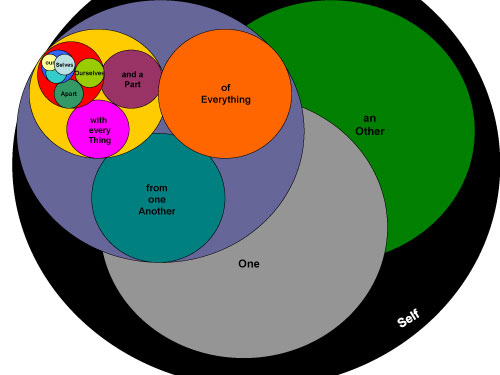
Oneself
our Selves, Ourselves
Apart and a Part
with every Thing, of Everything
from one Another, an Other
one Self
Here I offer up a poem of happenstance, and I love this 21st Century method for finding poems serendipitously.
What's my method? Look and listen to the moment. Let your intuition choose some words grounded in the world around you. Google them with "poem" at the end and see what pops up.
How did I do it? I was winding down after an incredibly intense Friday-before-finals by writing while watching an episode of the PBS cooking show Simply Ming. In this episode, Ming Tsai visited Iron Chef Masaharu Morimoto to cook fish. I wasn't that interested in cooking fish, but Morimoto is a fascinatingly expert "Zen master" of his craft, so I immediately Googled "morimoto poem".
What did I get?
The above is from the fascinating blog of David Morimoto, "Math Poet" and ecologist, conservation biologist, and animal behaviorist, who specializes in studying birds and teaches at Lesley University in MA. I found his image and poem comforting and grounding after a wild and chaotic day, and there's no doubt that many of my passions dwell in his area of expertise. In addition, I discovered the website Talking Writing, to which I will return when life calms down in a few weeks.
So why not search out a Googly-poem of happenstance for yourself?
MFB,
L
Apart and a Part
with every Thing, of Everything
from one Another, an Other
one Self
Here I offer up a poem of happenstance, and I love this 21st Century method for finding poems serendipitously.
What's my method? Look and listen to the moment. Let your intuition choose some words grounded in the world around you. Google them with "poem" at the end and see what pops up.
How did I do it? I was winding down after an incredibly intense Friday-before-finals by writing while watching an episode of the PBS cooking show Simply Ming. In this episode, Ming Tsai visited Iron Chef Masaharu Morimoto to cook fish. I wasn't that interested in cooking fish, but Morimoto is a fascinatingly expert "Zen master" of his craft, so I immediately Googled "morimoto poem".
What did I get?
The above is from the fascinating blog of David Morimoto, "Math Poet" and ecologist, conservation biologist, and animal behaviorist, who specializes in studying birds and teaches at Lesley University in MA. I found his image and poem comforting and grounding after a wild and chaotic day, and there's no doubt that many of my passions dwell in his area of expertise. In addition, I discovered the website Talking Writing, to which I will return when life calms down in a few weeks.
So why not search out a Googly-poem of happenstance for yourself?
MFB,
L
Saturday, January 19, 2013
Famous : Poem In Your Post
The river is famous to the fish.
The loud voice is famous to silence,
which knew it would inherit the earth
before anybody said so.
The cat sleeping on the fence is famous to the birds
watching him from the birdhouse.
The tear is famous, briefly, to the cheek.
The idea you carry close to your bosom
is famous to your bosom.
The boot is famous to the earth,
more famous than the dress shoe,
which is famous only to floors.
The bent photograph is famous to the one who carries it
and not at all famous to the one who is pictured.
I want to be famous to shuffling men
who smile while crossing streets,
sticky children in grocery lines,
famous as the one who smiled back.
I want to be famous in the way a pulley is famous,
or a buttonhole, not because it did anything spectacular,
but because it never forgot what it could do.
- Naomi Shihab Nye
Another of my favorites from Poetry Out Loud, I learned this one a few years back. May we all be famous.
MFB,
L
MFB,
L
Saturday, January 12, 2013
The Promise : Poem In Your Post
to the cut flowers.
They bowed
their heads lower.
Stay, I said to the spider,
who fled.
Stay, leaf.
It reddened,
embarrassed for me and itself.
Stay, I said to my body.
It sat as a dog does,
obedient for a moment,
soon starting to tremble.
Stay, to the earth
of riverine valley meadows,
of fossiled escarpments,
of limestone and sandstone.
It looked back
with a changing expression, in silence.
Stay, I said to my loves.
Each answered,
Always.
- Jane Hirshfield
My ultimate choice for Poetry Out Loud. I haven't learned a Hirshfield poem in by heart, although "The Gods Are Not Large" is one of my all-time favorites. The images here, and the lightly pessimistic humor engaged me and I suspect will do so for all. I'm planning to learn both poems for Poetry Out Loud next week, and you can check out "The Gods Are Not Large" on an earlier "Poem in Your Post" entry. There's an interview with Ms. Hirshfield there too.
If you find this poem intriguing, sample more at her author site on poets.org.
MFB, aloud,
L
- Jane Hirshfield
My ultimate choice for Poetry Out Loud. I haven't learned a Hirshfield poem in by heart, although "The Gods Are Not Large" is one of my all-time favorites. The images here, and the lightly pessimistic humor engaged me and I suspect will do so for all. I'm planning to learn both poems for Poetry Out Loud next week, and you can check out "The Gods Are Not Large" on an earlier "Poem in Your Post" entry. There's an interview with Ms. Hirshfield there too.
If you find this poem intriguing, sample more at her author site on poets.org.
MFB, aloud,
L
Saturday, January 5, 2013
It would be neat if with the New Year : Poem In Your Post
I could leave my loneliness behind with the old year.
My leathery loneliness an old pair of work boots
my dog vigorously head-shakes back and forth in its jaws,
chews on for hours every day in my front yard—
rain, sun, snow, or wind
in bare feet, pondering my poem,
I’d look out my window and see that dirty pair of boots in the yard.
But my happiness depends so much on wearing those boots.
At the end of my day
while I’m in a chair listening to a Mexican corrido
I stare at my boots appreciating:
all the wrong roads we’ve taken, all the drug and whiskey houses
we’ve visited, and as the Mexican singer wails his pain,
I smile at my boots, understanding every note in his voice,
and strangers, when they see my boots rocking back and forth on my
feet
keeping beat to the song, see how
my boots are scuffed, tooth-marked, worn-soled.
I keep wearing them because they fit so good
and I need them, especially when I love so hard,
where I go up those boulder strewn trails,
where flowers crack rocks in their defiant love for the light.
- Jimmy Santiago Baca
Another Poetry Out Loud frontrunner, and a favorite poet of mine. What a life he has experienced, and now, in addition to what's noted below, Baca works regularly with at-risk kids and has published a book for teachers on how to support them via literacy.
Jimmy Santiago Baca
b. 1952

MFB,
L
Subscribe to:
Posts (Atom)