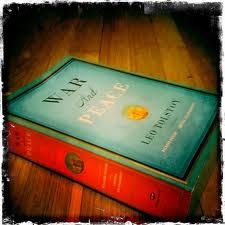
Showing posts with label War and Peace. Show all posts

Wednesday, August 17, 2011

War & Peace Wednesday: FAIL.

Time for a reality check, my friends. 

Unexpected professional responsibilities (a 3 day training in Seattle plus 2 full days of prep for classes, dealing with snafus getting my files and furniture set up in my new room, and crafting curriculum with colleagues) plus a spate of extraordinarily fine, sunny weather in what has been an unusually gray and dreary summer conspired to keep Tolstoy at bay. 

Here it is:  I have not done the reading.  And it's not just the external influences that have slowed me down.  It's the novel itself.  But it's not how you'd imagine.

It's because I'm loving this book.  Truly loving it.  Seems paradoxical, but all you readers know exactly what I'm talking about.  When you come to feel that the characters in the book are an integral part of your life, you don't want to rush through the text just to meet a deadline.  Instead, you want to savor every moment.  So rich, so thought provoking, and so current is War & Peace, despite its focus in Russia during the Napoleonic wars, that I don't want to sacrifice my reading experience to expediency.

Can you remember back to the books you loved so much that you were willing to defy your own predetermined pace just to keep experiencing them on their own terms, for as long as possible? 

Which books were they?  I wrote about a few of mine yesterday for the Broke and the Bookish's ''reader's choice" Top Ten Tuesday, and I hope to read any of the ones you adored that I haven't yet experienced.

So while I'm waiting on a rainy day to get back to War & Peace, what savor-worthy story should I add to my TBR list?

MFB,
L

Wednesday, August 10, 2011

War & Peace Wednesday: The Politics of War (and Peace)

Welcome back from our mid-summer break, War & Peace read-alongers.

If you're new to our featured read-along, here's what you need to know:  We took on the ultimate Tolstoy chunkster in July and are now officially past the half-way mark.

By the end of August, we'll be able to say that we are among the few, the proud, the War & Peace-ers.

Here's the upcoming schedule (also accessible on the Read-Alongs tab above):
8/17:  Book Three, Part 3 and Book Four, Parts 1 & 2
8/22:  Book Four, Parts 3 & 4
8/29: Epilogue & Whole Book Discussion

Today's post features Volume Three, Books One and Two.  No spoilers this time, but rather some general reflections on the merits of this particular chunkster....

   So, at this point one feels as though the major characters are simply a part of one's own life, and one actually looks forward to experiencing their shifting perspectives and personal development.  I'd say that's one of Tolstoy's strengths in War and Peace, as opposed to Anna Karenina: All of the major characters are dynamic as they keep shifting, learning, and changing quite realistically over the course of the novel, so even if they're not entirely sympathetic, they're entirely 'real' to us. What an achievement, when you think of it: These characters - Prince Andrei, Nicolai Rostov, Pierre, and even (drat it!) Natasha Rostov - shift not only their psychological stances but also their deeper philosophies as a result of their life experiences and - with all this novel's length - we trace their personal evolution beside them. 

   This aspect of War and Peace is truly quite enthralling and, having wished I'd never spent all those hours slogging through Anna Karenina, I did not expect it from Tolstoy.  As you can imagine, knowing that the enormous investment of time will be immediately rewarding page by page makes facing the sheer heft of this small-print, 1200+ page tome more than bearable.  And I already anticipate my own typical action when faced with the waning pages of a novel that creates a world - as War and Peace indubitably does - and offers characters who feel like friends, neighbors, colleagues: I'll be slowing down my pace to make the end of this one last.

    This time around, I'm not going to offer a plot summary, just a brief synopsis focused on theme: 
    More Napoleonic wars ensue, and the focus in these volumes offers us nuanced scenes of the politics among heads of state, local aristocrats and businesspeople, plus reflections on war as a recurring, seemingly inevitable aspect of human social behavior.  The war focus is balanced, of course, by the static - or predictably recurring - nature of life among the peace-ers: those left behind at home.     
    Military service as a refuge from one's personal responsibilities back at home is a recurring theme as well, making us question our assumption that those who enlist do so as patriots or courageous idealists or self-sacrificing heroes for the community, and offering an alternative motive, especially for those characters who come from privilege and can thus pick their positions within the military: It's a way to escape the decision-making of their peacetime lives and perhaps earn glory among men along the way.

  Here's to an increasingly rich and enjoyable journey into past, fictional lives, yet with thought-provoking implications for our current real ones.

Shout out to Laura at Booksnob blog, who's also posting about her War & Peace reading experiences.

MFB,
L

Wednesday, July 27, 2011

War and Peace Wednesdays: Yay! It's fun again!

Whew.  What a relief. 

In Volume II, Parts 4 and 5, Tolstoy turns up the heat on many relationships, turns on the plot, and turns in a soap-opera-esque, boffo little 130-page section.  So we're back on track.

Lessons: 
  • Persevere. 
  • And look to like-minded readers for support and encouragement.  My thanks to Ingrid at The Blue Bookcase:  Her statement that the final third of War & Peace is by far the best will kept me reading!  Also gratitude to Laura at Booksnob who's reading along, and to my IRL book groupies with whom I'm scheduled to meet next week to discuss the first 1/2 of the chunkster.
In this section it's the soap opera plot that's so infectious, so I'll offer just a breezy summary-with-implied-commentary.

To sum up: Part Four.
    Count Rostov Sr. can't bring himself to actually pay attention to his money, so their family finances decline precipitously, requiring that Nikolai eventually accede to his mother's pleas and take a leave from his much-loved army life (virtually no responsibilities or personal decision making = Nicky's favorite aspects of the military) and returns to Otradnoe.  He is of zero help to his family, and doesn't ever acknowledge that his huge gambling debt - paid by his father - is what set them on this road to financial ruin.  It's an "apple doesn't fall far from the tree" section:  Count Elie Rostov, Nikolai's dad, is equally unwilling to acknowledge reality and so continues to spend, spend, spend until he's forced to sell off properties just to meet his expenses.  This can't go on for long, one senses.
     Then:  Wolf hunt.  Really.  Nikolai loves hunting, so he rounds up the umpteen servants and horses and dogs required and joins neighbors on a staged/somewhat controlled hunt.  There was a snipe hunt in Anna Karenina, and in this one: bigger game, more hunters, more dogs, more interpersonal and inter-canine drama.  Me personally: Not big on hunting.  But Tolstoy's vigorous descriptions do cause one to sit up and take note of how passionately Russian aristocrats dedicated themselves to this 'sport'.
     Then Nikolai, falling in love again with Sonya when she dresses up like a man for 'mumming' at Christmas (OK: how many hints do we need about Nikolai??), fights with his mom, who disapproves of the dowry-less match, then returns to the army to escape his family responsibilities.

To sum up: Part Five.
     Old count Rostov takes Natasha and Sonya to Moscow to deal with finances and get away from the dramas in Otradnoe.  Pierre also arrives in Moscow, staying with the increasingly nasty and somewhat senile old Prince Bolkonsky and his plain, increasingly terrified, always beleaguered daughter Marya. 
     Boris is back.  And social climbing to beat the band.  He proposes to Marya's friend Julie, whose family money and position will propel him one step up the social ladder.  Natasha and fam. decide to visit the geezer Bolkonsky to try to win him over so Natasha can marry Prince Andrei soon (she's getting impatient about squandering her youthful fabulousness), and with his blessings.  No dice.  So no dice.  Their visit makes matters much worse.
     Then, at the theater, and then at a party thrown purposefully by his sister Helene to get them together, Natasha gets introduced to the dashing cad Anatole, whose well-perfected wooing and handsome visage enrapture her.  Bye-bye, Andrei; hello, Anatole.
     Sonya tries to prevent this bad situation from getting worse, but Natasha's stupid obstinacy is no match for her quiet cousin's acts and arguments. 
     The whole Kuragin clan is a festering bunch of bad apples, with Anatole possibly the nastiest bite in the barrel. Oh, did I mention that he's already married, but to a peasant (ye olde shotgun wedding), so he doesn't care and doesn't tell anybody about it?  Yes.
     Even though the planned elopement gets foiled and Anatole runs away, Natasha's already sent a letter to Marya rejecting Prince Andrei in favor of the somewhat-currently-more-jerky of her two suitors, 'cause that's just the kind of ditz she is.  Andrei's cool with that, and Pierre attempts to smooth things over with everyone, whereupon he falls in love with Natasha too.  Then the comet of 1812 flashes through the sky: It's Pierre's joy!

Yup.  Told y'all: Soap opera.  But with many unexpected plot turns and a lot more fun than the last section, I'll take it.

MFB, with Volume Three (Parts 1 & 2),
L

p.s. Nifty tip for all War & Peace-ers:  Book Drum now has illuminations (photos, paintings, videos, historical info.) for bookmarked sections of the novel, and there's a quick-n-interesting bio that tells us - among other intriguing tidbits - that nasty ole Count Bolkonsky is modeled after Tolstoy's own grandfather and that Tolstoy's thinking inspired the young Mohandas K. Gandhi.  True.

Wednesday, July 20, 2011

War & Peace Wednesday: When Is Enough Enough?

This section, Volume 2, Parts 2 & 3, follows the transformations of Pierre and Prince Andrei.  The former becomes a Mason while the latter falls in love.  That's basically it.

To be honest, this section bored me silly, quite contrary to the last sections, which kept me intrigued and excited to continue.  I came to wonder:  When is enough enough?  And when is an abridged version OK? (The latter's a question that arose as I visited new blogs on yesterday's Top 10 Tuesday hop as well.)

(SPOILER PARAGRAPH BELOW, then back to non-spoiler wrap-up...)
Why was I wondering?  Well, it's pretty dull stuff to watch one quirky, spacey, bumbling buffoon turn into an upstanding quasi-religious man and get back together with his beautiful but shallow and boring wife.  Also dull? To watch an annoyingly condescending character vacillate among various equally privileged life paths, then fall in love with a ditz-brained 16 year old (yes, it's the famous Natasha, and I still don't see how she's going to pan out to be an interesting or worthy character, but hope springs...). Sigh.

I can't even bring myself to offer my three-somes this time, because, frankly, nothing stands out.  Sorry friends, but that's just the way I'm seeing it.

But it's quite possibly not how Tolstoy's original readers saw it.  In fact, they saw it in installments, as a serialized novel.  Think Dickens, but with more upper-crusty characters (Dickens meets Austen in St. Petersburg?).  And - as with every single Harry Potter book - traditional plotting/pacing dictates that there must be some slow sections to ramp up for the high-intensity wand-fights with Voldemort.  I'm still feeling a little skittish though, because in Anna Karenina the wand-fights never materialized: no real pay off, intensity-wise.  Oh, plot happened.  But the climax definitely didn't justify all the boring sections.  Fingers crossed that this one'll be more rewarding in the end.

So here's my question:  When a work is sucking down your summer, pulling you under with a sense of obligation sans reward, how many pages must you read before it's OK to say, "My one wild and precious life is more important than having read yet another Tolstoy chunkster?"  What's the point at which you're not wimping out or selling yourself and your writer short, but rather saving you both?  I'll definitely keep going - for now - but this question is truly vexing me, and I'd appreciate your help.

On a positive note:  One more section (Volume 2, books 4 & 5) and we're half way through! 

So for those of you reading along, let's just take a deep breath, dive in again, and get through this together.

MFB, and it's gotta get better from here,
L

p.s.  For an alternate perspective, you might want to visit Laura at Booksnob who's reading this with us...

Wednesday, July 13, 2011

War and Peace Wednesdays: So Far, Way Better Than Anna Karenina!

That's my opinion, and I'm stickin' to it!  Although I'm only 1/4 of the way through at page 346 in my edition, I'm finding War & Peace so much more interesting and entertaining in every way than Anna.

I wonder if reading the latter chunkster last summer primed the literary pump here, or if War and Peace would have struck me as this enjoyable if I'd read it a year ago instead.  Surprisingly, I'm still engaged by the dual foci of the sociology/psychology of the men when they're actively engaged in military maneuvering and battles versus the subtle and substantive domestic dramas of the families (and the same men) at home.

This section breezed by, relatively speaking for such a literally and figuratively hefty work, with unexpected plot turns and character developments galore.

And for Three Tempting Threesomes in this section of War & Peace... (possible spoilers, but good stuff!)

Wednesday, July 6, 2011

War and Peace Wednesday : The Read-Along Begins with Threesomes

In our first read-along for this worthy chunkster*, we took a bit bite: Volume One, Parts One and Two.  In my version, that meant 200 pages of English and French, at least 100 characters, and scores of place names in Russia and Austria and France that required umpteen map references to picture in their relative positions. 

To sum up: Part One focused on Petersburg and Moscow society - its parties and gossip and domestic intrigues, and Part Two brought us into the Napoleonic wars in Braunau, Vienna, Enns, Brunn, Tabor, Hollabrunn, and Schongraben alongside the ambitious Prince Andrei Bolkonsky and the youthful idealist Count Nikolai Rostov, our two primary characters who bridge both sections.  (Dunno if they will continue to be the main two, but they are so far.)

In a nod to our three word title and to Tolstoy's famous short fiction, "Three Questions", I'll offer my three favorites from Volume One, Parts 1 & 2 in four categories:  (Some spoilers here, so proceed with caution!)

Most memorable moments:
  * When the scheming Anna Mikhailovna assists oblivious/innocent Pierre Bezukhov in confronting the equally-sneaky-and-money-grubbing but a lot less likable Princess Catishe Bezukhov and Prince Vassily Kuragin about the dying Count Bezukhov's will.  This provided a refreshing darkly comic and dramatic plot point amid the more languid and meandering events of Part One. (85)

* "The fog of war": In the final battle scenes, the chaos of battle, redefined in retrospect as ordered military maneuvering, and especially the moments in which Prince Bagration appears to transform chaos into perceived order for his troops simply by his commanding and situationally apt responses to disordered and shifting circumstances.  (many scenes in Part Two)

* The moment when Nikolai stands overlooking the beautiful, sun-struck valley of the Danube and realizes that his fantasy of soldiering is just that, and he really doesn't want to die.  (148-149)
               
Favorite lines or passages: (The first two are entirely idiosyncratic, the third at least a tad more thematically resonant)
* "Intriguer!"  Isn't it wonderful that this is the most shocking insult Princess Bezukhov can hurl at her arch-enemies at the most pivotal moment in her life?  I am now going to point my finger at any misbehavior and growl it out, French accent and all. 

* "Boris and Natasha": Inappropriate, I know, but every time their names appeared in the same passage, I flashed on the cartoon characters and got the giggles. And, let's face it, I needed a little comic relief!

* This passage, noted above, in which Nikolai finally "gets it": 
'Ooh! Leave me alone, for Christ's sake," the wounded man cried; but all the same they lifted him up and laid him on the stretcher.
   Nikolai Rostov turned away, and, as if searching for something, began looking at the distance, at the waters of the Danube, at the sky, at the sun!  How good the sky seemed, how blue, calm,  and deep! How bright and solemn the setting sun!  how tenderly and lustrously glistened the waters of the distant Danube!  And better still were the distant blue hills beyond the Danube, the convent, the mysterious gorges, the pine forests bathed in mist to their tops...there was peace, happiness...'There's nothing, nothing I would wish for, there's nothing I would wish for, if only I were there,' thought Rostov.  'In me alone and in this sun there is so much happiness, but here...groans, suffering, fear, and this obscurity, this hurry...Again they're shouting something, and again everybody's run back somewhere, and I'm running with them, and here it is, here it is, death, above me, around me...An instant, and I'll never again see this sun, this water, this gorge...'
   Just then the sun began to hide itself behind the clouds.  Ahead of Rostov, another stretcher appeared.  And his fear of death and the stretcher, and his love of the sun and life - all merged into one painfully disturbing impression.
   'Lord God! the one there in this sky, save, forgive, and protect me!' Rostov whispered to himself.
                                                                                                                (148-149)
Most intriguing descriptions:
* Princess Liza's face - I cannot stop picturing her hairy hair-lip touching her plump lower lip as she gossips incessantly.  And I continue to ponder how - however lightly ironic Tolstoy's description - she could be perceived as beautiful.

* The many descriptions of the pastoral, almost bucolic landscapes upon which the soldiers would soon smear mud and blood into chaos.

* Tolstoy's contrasting interior monologues of Nikolai, Andrei, and Tushin as they react to the conditions of war:  the young man with dashed hopes of glory replaced by confusion and the quickened awareness of his own mortality; the ambitious career man with intense presence in the moment and proud, wistful nostalgia in retrospect; and the workaday soldier overwhelmed by a sort of trance-like fantasy in the heat of battle,, who's addled to confusion in retrospect.

Questions:
*  I've heard that Natasha is a major character, so how will Tolstoy shift the focus onto her when the very title of the novel indicates that we'll be moving back and forth between two contexts and she'll likely only be present in one of them?

*  Will Prince Andrei turn out to have enough redeeming qualities that we readers actually come to appreciate him, however much of a jerk he seemed to be in the Part One?

* Are the insights about male soldiers' and politicians' and diplomats' and aristocrats' psychologies and group sociology simply going to be amplified and repeated in the rest of the novel, or will Tolstoy offer additional insights? 

I had to do it.

My actions: To thoroughly read the introduction before continuing to Volume One, Part 3 and Volume Two, Part 1.  And to research a bit more on these battles...I fear I'm woefully unfamiliar with the historical details here! 

See you next week, and don't be shy about jumping in with your own two cents, even if you read War and Peace years ago...

MFB, with the uber-chunkster,*
L

* Chunkster = hefty, hefty tome, usually "a classic"

Monday, June 27, 2011

'War and Peace' and a Poem about New Zealand

Aotearoa

They always say ‘retrace your steps’,
‘Click your heels three times: There’s no place like home,’
‘Where do you last remember them?’

But what if you’re far from the familiar, not in but out,
if they’re not to be found on the carpet
beneath a pile of half-folded laundry,
in the kitchen in the fridge in the vegetable bin with the broccoli,
still in the ignition, with the doors locked?

And what if your steps are slides
against the current, pushing past fear
into a coastline not as civilized as soap,
but lethal, dark, peopled with voices
not yet heard by men?

Then, if you are Kupe, what they say
will not do.
To find your keys, look up.
They’re in the clouds.


I wrote this for the "Word and Question" monthly challenge at Shredded Cheddar.  You submit a word and a question, then the host mixes and matches the words and questions at random and sends you a new word & question, from which you create a poem.   Many thanks to Enbrethiliel for organizing this monthly play-for-mortal-stakes: Talk about a creativity-booster!

My word was Aotearoa (the Maori word for New Zealand which translates roughly as 'land of the long, white clouds') and my question was, "Where are my keys?"  It took me three tries to get here:  first a villanelle that turned out lifeless and static, then a haiku that just didn't say enough, and then finally this free verse, which seems closer to the mark. 

What's the poem about?  Well, I researched Aotearoa and found the legend of Kupe, original explorer of Aotearoa, who used the clouds as guides and whose canoe was named after clouds as well.  I decided that he could ask the question, and I would offer the answer.  I think that the shift to something decent came when I decided to free up the form (more like Kupe's exploration), and to directly address the disjunct between the contemporary question and the mythic word.

War & Peace Summer Read-Along (6/24/11-8/22/11)
And now, on a completely different note:  Details for the War & Peace Summer Read-Along.
Let's try talking about it weekly, on Mondays, starting a week from today.  I'll make that section shorter so you can go get the book. Just "sign up" in the comments; I'm working on a button...

7/6: Book One, Parts 1 & 2
7/13: Book One, Part 3 and Book Two, Part 1
7/20: Book Two, Parts 2 & 3
7/27: Book Two, Parts 4 & 5
8/3: Book Three, Parts 1 & 2
8/10:  Book Three, Part 3 and Book Four, Parts 1 & 2 
8/17:  Book Four, Parts 3 & 4
8/24:  Epilogue & Whole Book Discussion

FYI:  No pressure.  If you jump in late or if nobody wants to read-along right now, that's actually fine because I'm reading it for my book group anyway - we're breaking it into two discussions, 1/month, but if you decide you want to read it with me, that'd be swell.   I'll just post a few thoughts on each Monday, trying to avoid spoilers.  Maybe my musings will pique your interest...

MFB,
L
Related Posts Plugin for WordPress, Blogger...